Just when the global motorcycling industry believed the internal combustion engine (ICE) had reached its developmental ceiling under stringent Euro 5+ emissions rules, Honda has detonated an engineering bomb. Unveiled in production-intent trim at EICMA under the vanguard Flagship WING emblem, the Honda V3R 900 E-Compressor introduces the world’s first production motorcycle engine equipped with an electronically controlled supercharger.
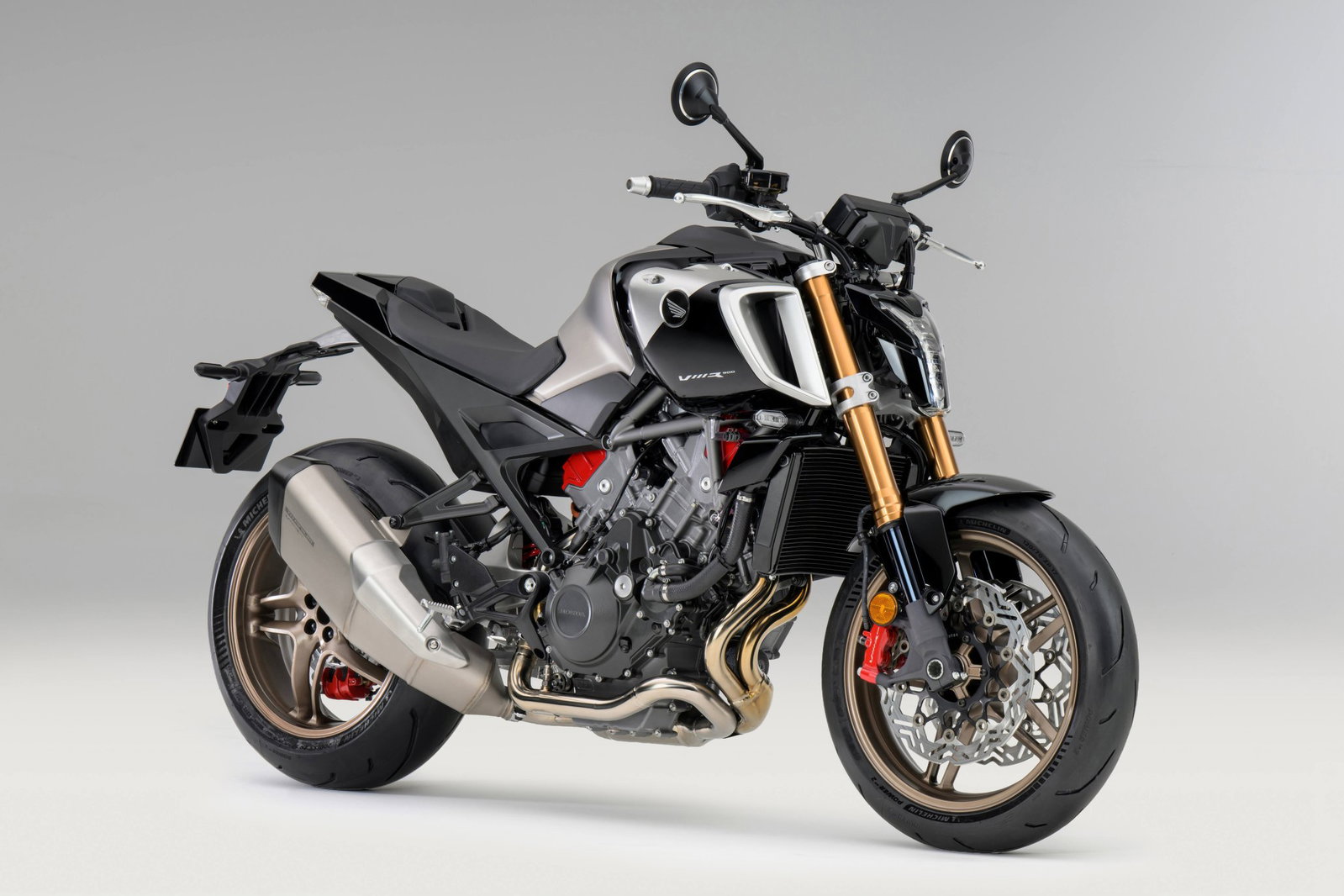
Unlike traditional exhaust gas-driven turbochargers that suffer from noticeable lag, or crankshaft-driven centrifugal superchargers that sap parasitic power at idle, Honda’s E-Compressor operates completely independently of engine RPM. By combining a 75-degree liquid-cooled V3 layout with active electric boost modulation, Honda has achieved 1,200cc-class torque and acceleration from an agile, lightweight 900cc footprint.
1. The Mechanical Blueprint: Why a 75-Degree V3?
Honda’s romance with the V3 engine layout stretches back to iconic Grand Prix racers like Freddie Spencer’s NS500 two-stroke and the legendary street-legal NS400R. However, the V3R 900 reinterprets this layout for a modern, high-efficiency four-stroke era:
- Cylinder Architecture: Two front-facing banked cylinders paired with a single rear-facing vertical cylinder, oriented at a narrow 75-degree V-angle.
- Extreme Lateral Slimness: Because the engine has only two cylinders across its widest axis, the frontal cross-section is significantly narrower than an inline-four or inline-three engine. This slashes aerodynamic drag and allows extreme lean angles.
- Packaging Advantage: The space carved out behind the front cylinder bank and above the gearbox creates the ideal cavity for the electric motor and compressor turbine, centralizing vehicle mass directly below the rider’s knees.
- No Intercooler Required: Through precision pulse-width electrical control, intake air pressure is calibrated dynamically to prevent charge-air overheating, completely eliminating the weight, bulk, and plumbing of a front-mounted intercooler.
2. How the E-Compressor System Works
The core technological marvel of the V3R 900 is its high-speed brushless electric motor driving an ultra-lightweight compressor impeller. Traditional forced induction relies on exhaust gas volume (which takes time to spool up) or belts attached to the crank (which can produce abrupt power spikes). Honda’s electronic system solves both challenges simultaneously:
- Sub-Millisecond Spool Up: The high-output electric motor can spin the impeller from 0 to over 100,000 RPM in milliseconds, delivering maximum boost pressure from as low as 2,500 RPM.
- Zero Throttle Lag: The engine management system anticipates torque demand based on ride-by-wire twist grip sensor velocity, priming boost before the throttle butterflies have even reached full aperture.
- Linear Power Delivery: At redline, the electric motor dials back turbine speed to avoid detonation, providing a seamless, flat torque plateau that mimics a massive, naturally aspirated liter-plus powerplant.
3. Specifications Overview: V3R 900 vs Superbike Benchmarks
| Technical Parameter | Honda V3R 900 E-Compressor | Ducati Streetfighter V2 | Yamaha YZF-R9 |
|---|---|---|---|
| Engine Layout | 75° Liquid-Cooled V3 | 90° Superquadro V-Twin | 890cc CP3 Inline-3 |
| Induction Method | Electronic E-Compressor | Naturally Aspirated | Naturally Aspirated |
| Target Output | ~155 – 165 HP (1,200cc Torque Class) | 153 HP @ 10,750 RPM | 119 HP @ 10,000 RPM |
| Torque Curve | Immediate low-RPM electric boost | Peaks @ 9,000 RPM | Linear mid-range torque |
| Chassis Construction | Steel Trellis + Stressed Engine | Aluminum Monocoque | Deltabox Aluminum |
| Fuel Tank Material | Sculpted Titanium | Steel / Aluminum | Pressed Aluminum |
| Exhaust Headers | Titanium Anodized | Stainless Steel | Stainless Steel |
4. Exotic Chassis, Aero & Artificial Intelligence
Honda did not treat the V3R 900 as an engine testbed; the rolling chassis is a masterclass in weight discipline and aerodynamic asymmetry:
Titanium Fuel Tank & Headers: To offset the battery and high-voltage inverter weight required to drive the E-Compressor, Honda handcrafted the fuel tank and forward exhaust downpipes out of titanium. The result is a bike that sits comfortably under the 200 kg (440 lbs) wet threshold.
Asymmetric Ram-Air Ingestion: The flanks of the tank feature asymmetric carbon composite scoops. The larger left intake channels clean ambient air directly into the electric compressor housing, while the right intake routes cooling airflow over the electrical controllers.
Next-Gen RoadSync with AI Voice Control: Debuting alongside the hardware is an updated TFT dash integrated with AI-driven voice commands. Riders can adjust traction control parameters, suspension damping, and boost aggressiveness hands-free through helmet intercom systems while riding.
5. Production Timeline & Market Impact
Honda has confirmed that the V3R 900 E-Compressor is not a concept exercise; it is an active production development program intended for public showroom rollout within the next 18 to 24 months. While final homologation figures and price tags remain closely guarded, Honda’s engineers have created a blueprint that allows internal combustion engines to stay thrilling, ultra-torquey, and environmentally compliant well into the next decade.
Stay tuned to Superbike Photos for live dyno numbers and track telemetry as Honda prepares this forced-induction icon for production. Planning your next high-performance machine? Check out our 2026 Superbike Ownership & Insurance Guide and our track-tested guide to the 5 Best Motorcycle Helmets Under $500.